

Research > Archaeological Fieldwork > Sapienza "Grandi Scavi" > Northeastern slopes of Palatine hill
Director: Maria Teresa D’Alessio
External links:
- Instagram: @pne_palatino_sapienza
- Roma: lo scavo archeologico della Meta Sudans e del Palatino nord-orientale
The north-eastern slope of the Palatine is the sector of the hill that today overlooks the Piazza del Colosseo, an area that in antiquity was occupied by a broad valley bounded on the other sides by the slopes of the Oppius and Caelian hills. The Colosseum, the Arch of Constantine, the eastern façade of the Temple of Venus and Roma, and the base of the Colossus of Nero now stand within this space. To the north, the corner of the hill is flanked by the so-called Via Sacra, which ascends towards the Arch of Titus and follows the line of the ancient route leading to the Forum square (the vicus Curiarum), which separated the Palatine from the Velia.
Since 2001, the Department of Sciences of Antiquity at Sapienza University of Rome, in collaboration with the Parco Archeologico del Colosseo, has been conducting excavations in this urban area, bringing to light a stratigraphic sequence that documents continuous occupation from the Iron Age to the post-antique period. The earliest occupation belongs to the protohistoric phase and is represented by terraces and huts dated to Latial phases IIA–III (c. 925–875 BC – eighth century BC).
During the Archaic period, the area housed the Curiae veteres, a sanctuary of Romulean tradition where members of the earliest civic curiae gathered to perform rituals and share communal meals. The stratigraphic sequence attests to continuous cult activity from the Archaic period through its monumentalisation in the Augustan and Julio-Claudian periods, already documented by Sapienza’s earlier excavations in the Piazza del Colosseo. From the second century BC onwards, wealthy domus developed alongside the sanctuary, including the birthplace of Augustus ad capita Bubula, as recorded in the literary sources. In the Julio-Claudian period, restoration works were undertaken and a temple was constructed, possibly identifiable with the shrine of the Divus Augustus, dedicated by Livia in AD 26 near the princeps’ birthplace; traces of rebuilding following the fire of AD 51 have also been identified. Outside the sanctuary stood the first Meta Sudans, a monumental truncated-cone fountain of Augustan date.
The great fire of AD 64, which broke out under Nero’s principate, resulted in a radical reconfiguration of the Palatine’s topography: the sector was rebuilt over substantial layers of fill and reorganised according to new orientations. Earlier investigations conducted by C. Panella made it possible to identify these transformations and the subsequent phases, when part of the district was incorporated into the project of the new imperial residence, the Domus Aurea, and later converted into storage facilities in the Hadrianic and Severan periods.
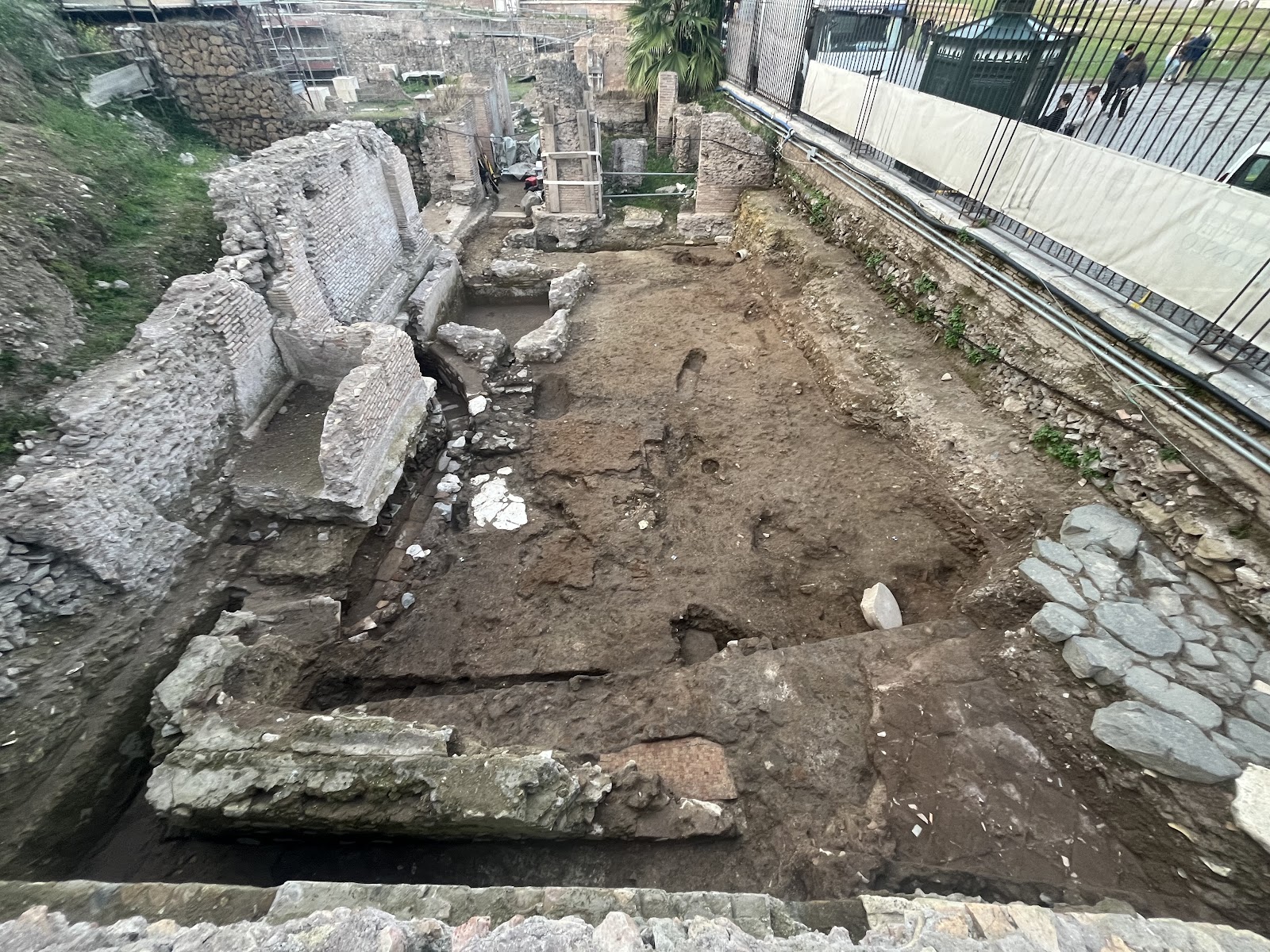
Excavations were extended southwards in 2017 at the eastern foot of the Palatine slope, integrating and expanding the picture that had emerged from previous investigations. Work reached the Julio-Claudian stratigraphy and brought to light the continuation of the temple’s foundations. Additional structures, still under analysis, are emerging from the fills accumulated in the Neronian period following the post-fire reorganisation.
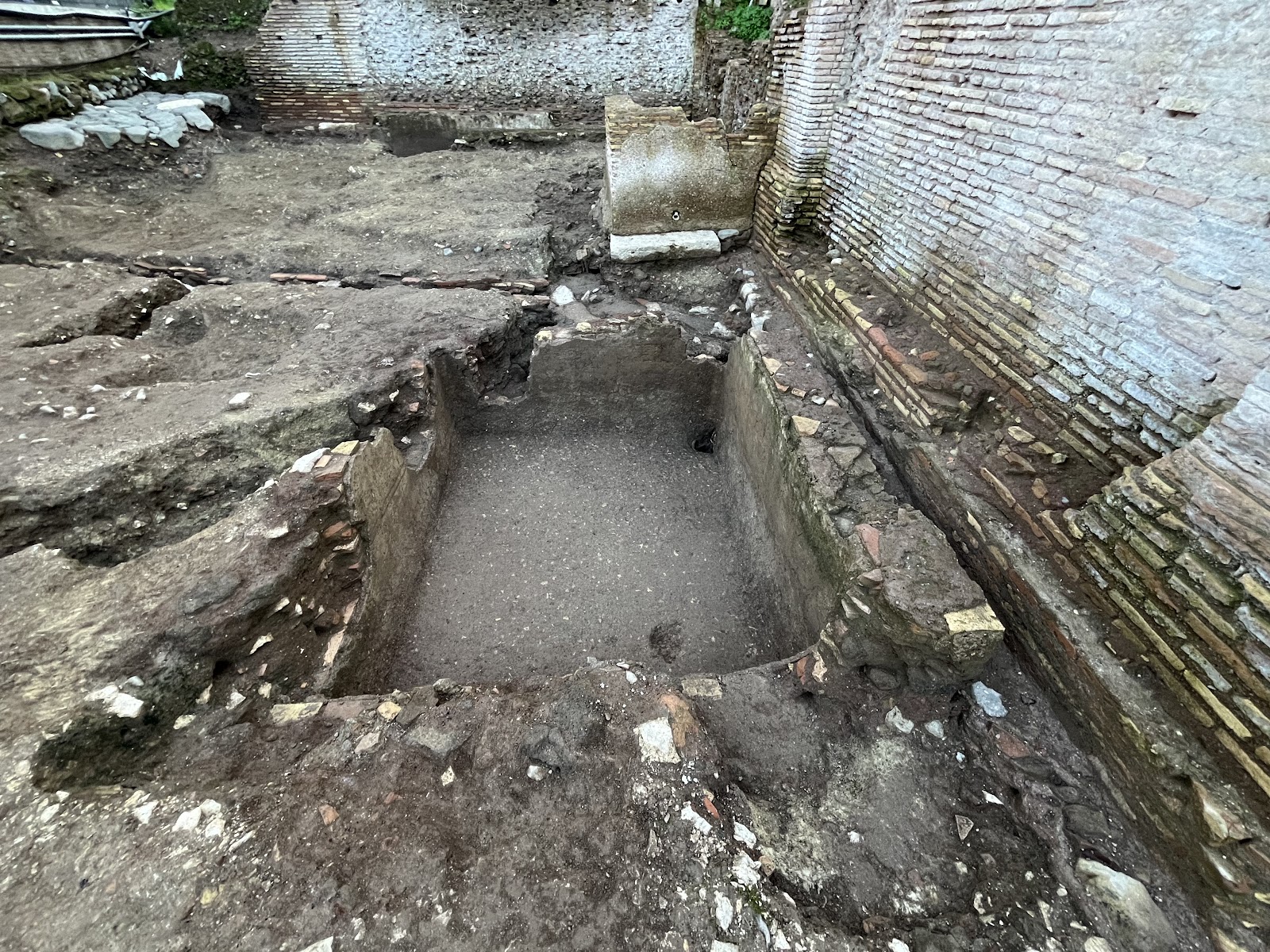
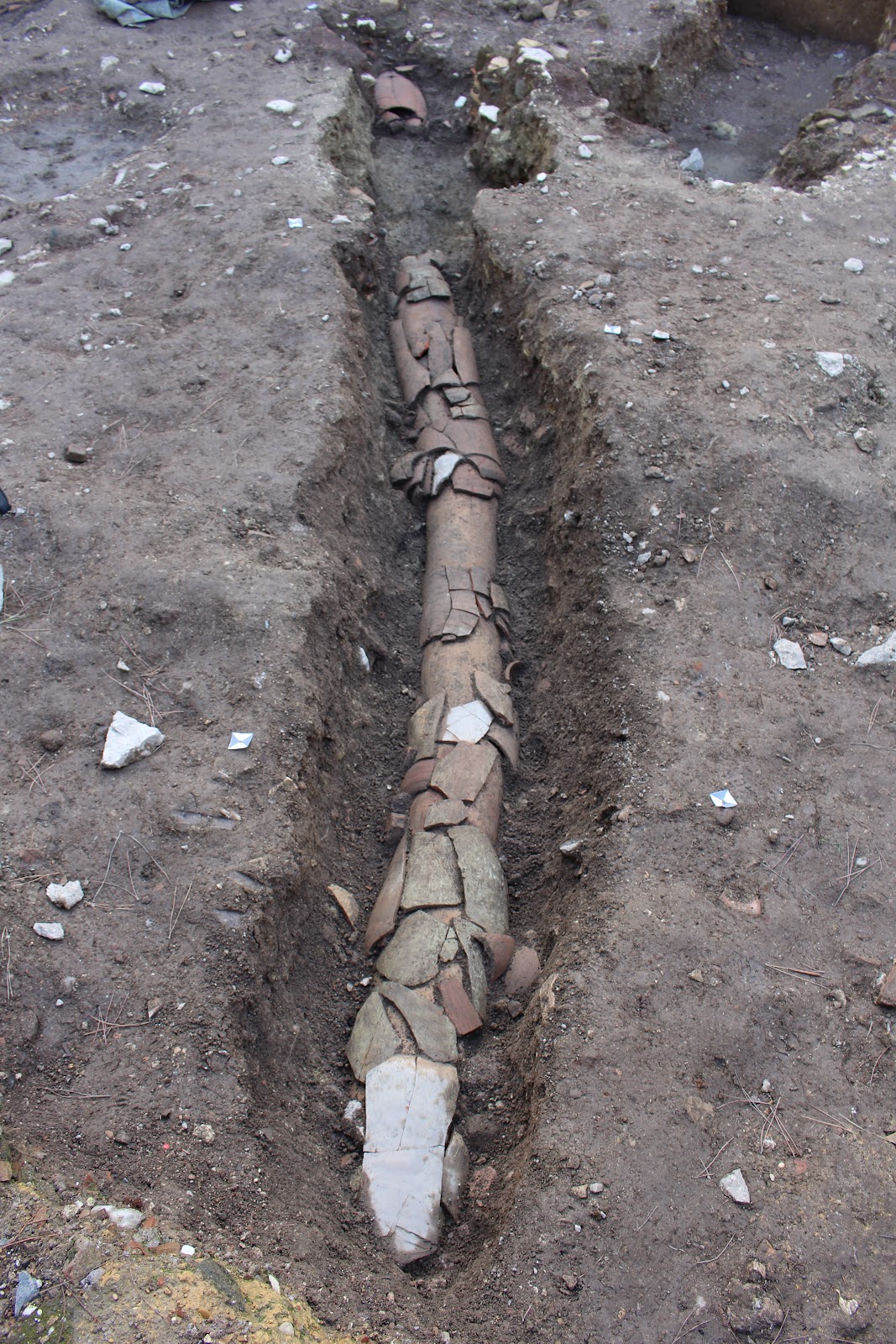
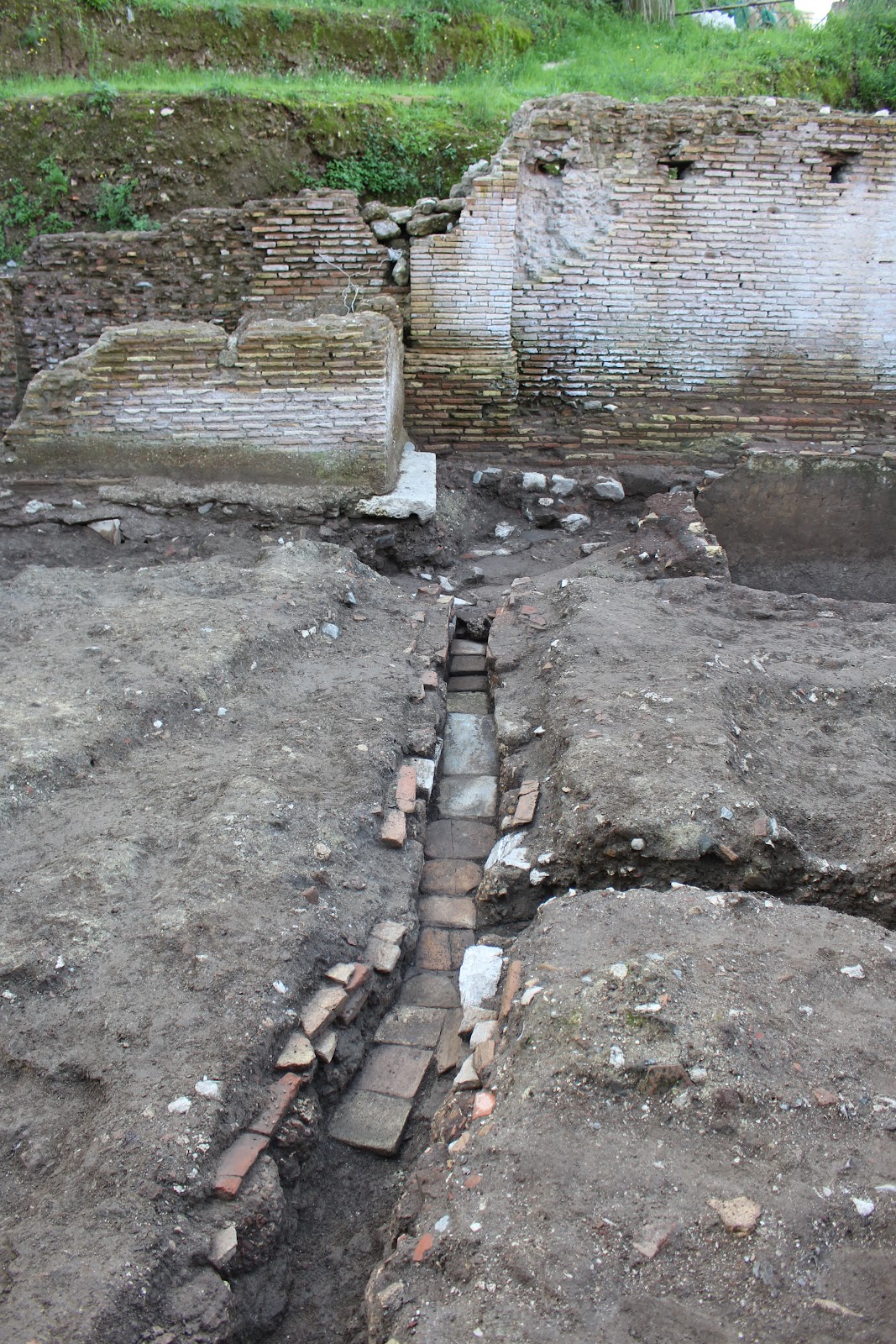
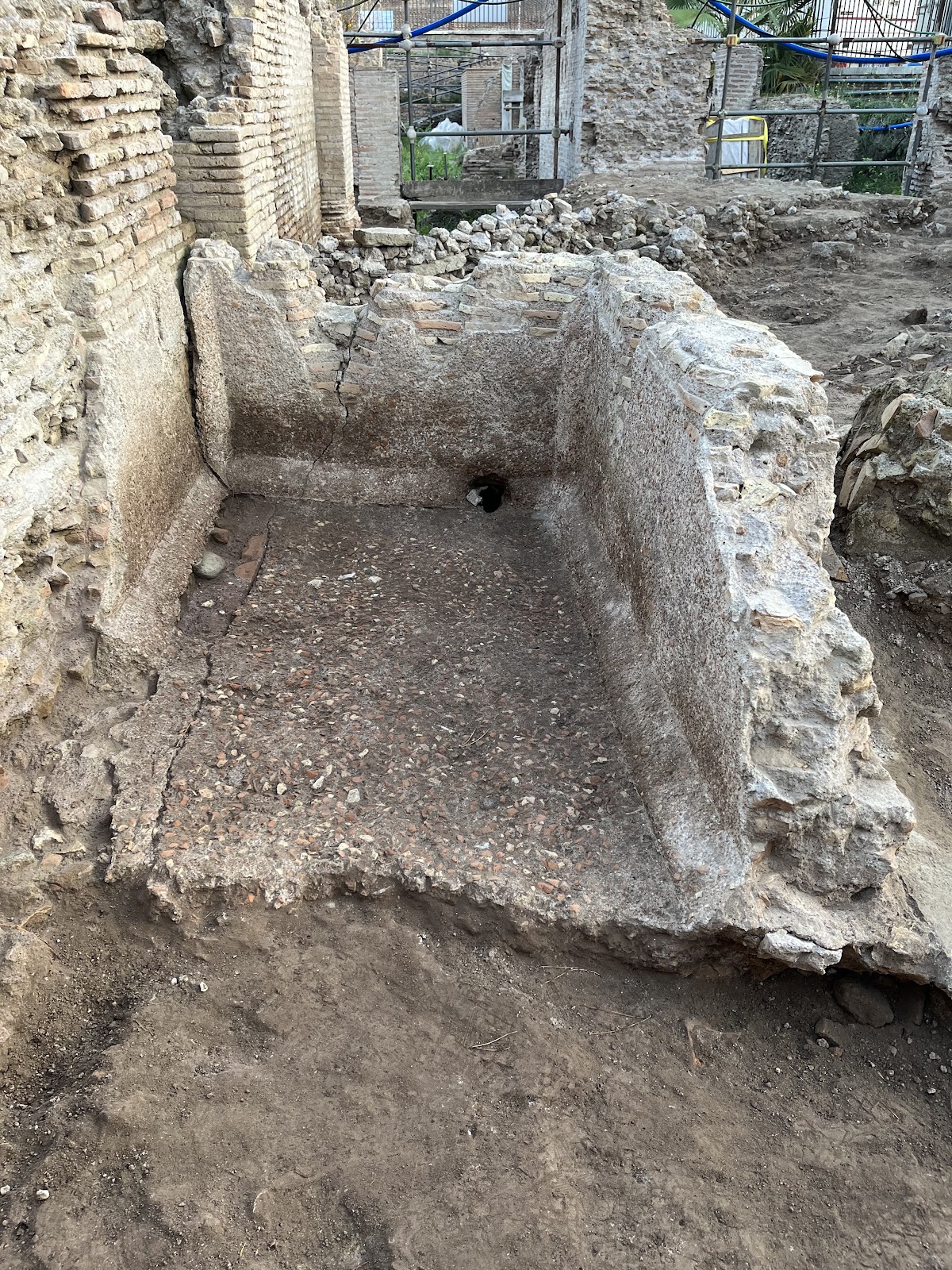
A brick-built structure has also been fully uncovered. It developed through several construction phases between the mid- and late Imperial periods and is characterised by a façade articulated by pilasters overlooking an open area. This open space has yielded important evidence for the Late Antique use of the site. In front of the mid-Imperial building, a basin was initially constructed, later obliterated by the laying of a basalt pavement that covered the open area around the mid-fifth century AD. Over the following fifty years, the paving was at least partially refurbished, and a workshop was installed within the building, as attested by the presence of a furnace together with slag and metalworking debris. A new basin and numerous drainage channels document the management and continuous disposal of water, probably in connection with these productive activities.
Taken together with the results of earlier investigations, these data provide a more complete picture of a Late Antique productive sector located on the slope of the Palatine. During the sixth century AD, the area underwent a further raising through the laying of a new paved surface and probably a change in function, marking the cessation of productive activities.
Later deposits, beginning in the Renaissance period, document the gradual abandonment and spoliation of the structures and of the area.
Collaborators:
- Nicolò Squartini
- Eraldo Avanzo
- Valerio Bruni
- Matteo Maira
- Samira Mele
- Federico Parisi
- Elena Pavanello
- Bibliography
BOSSI, S, SQUARTINI N. c.s., Dal Palazzo imperiale alle pendici palatine: i nuovi rilievi 3D, in M. IPPOLITI (a cura di), Atti della conferenza “La scena dell'imperatore. Lo spazio della corte e della comunicazione del potere”, 29 novembre 2024, Roma cds.
BOSSI S., SQUARTINI N., MELE S. c.s., Survey and elaboration of digital data for a stratigraphic analysis of pluristratified context: the s.c. Domus degli Americani (Palatine, Rome), in Archeologia e Calcolatori, in c.s.
CARANDINI A., CARAFA P., D’ALESSIO M.T., FILIPPI D. 2017 (a cura di), Santuario di Vesta, pendice del Palatino e via Sacra, Roma 2017.
D’ALESSIO M.T. 2019, Nuove indagini sulla pendice sud-occidentale della Velia, con un’Appendice di N. Squartini, in Scienze dell'Antichità 25.1, 2019, pp. 101-120.
D’ALESSIO M.T. 2021, Nuove indagini sulla pendice Nord-orientale del Palatino (2017-2020), in Scienze dell’Antichità 27.1, 2021, pp. 67-87.
D’ALESSIO M.T. 2023, Rinascimento e città: il ruolo dell’antico tra continuità e trasformazioni, in Don E. Bettini, D. Tondini (a cura di), Un nuovo Rinascimento per l’Europa: il ruolo della ricerca e della formazione, Atti del V Forum Internazionale del Gran Sasso (Teramo, 29 settembre – 1 ottobre 2022), vol. 5, parte 2, Teramo 2023, pp. 101-120.
D’ALESSIO M.T., FANELLI C., SQUARTINI N. 2023, Lo scavo alla pendice nord-orientale del Palatino: le ultime fasi di occupazione, in Scienze dell’Antichità 29.1, 2023, pp. 33-51
FERRANDES A.F. 2020, Tra Palatino e Velia. Santuari e domus sulla via per il Foro nella media età repubblicana, in A. D’Alessio, Ch. Smith, R. Volpe (eds), Roma medio-repubblicana dalla conquista di Veio alla vittoria di Zama, Atti del Convegno (Roma, 5-7 aprile 2017), Roma, pp. 27-49.
FERRANDES A.F. 2024, Strade, santuari e domus tra Palatino e Velia nella media età repubblicana (IV-III secolo a.C.). 1. Stratigrafie, contesti, ricostruzioni, Roma 2024.
Further details about this research:
- Research type: Sapienza "Grandi Scavi"
- Location of the excavation: Rome, Archaeological Park of the Colosseum
- Research topic: Methodologies of the Archaeological research
- Fundings: Grandi Scavi di Ateneo
| Image gallery | ||
|---|---|---|
 |  |  |
 | ||