

Research > Archaeological Fieldwork > Sapienza "Grandi Scavi" > Northern and Southern Slopes of the Palatine Hill
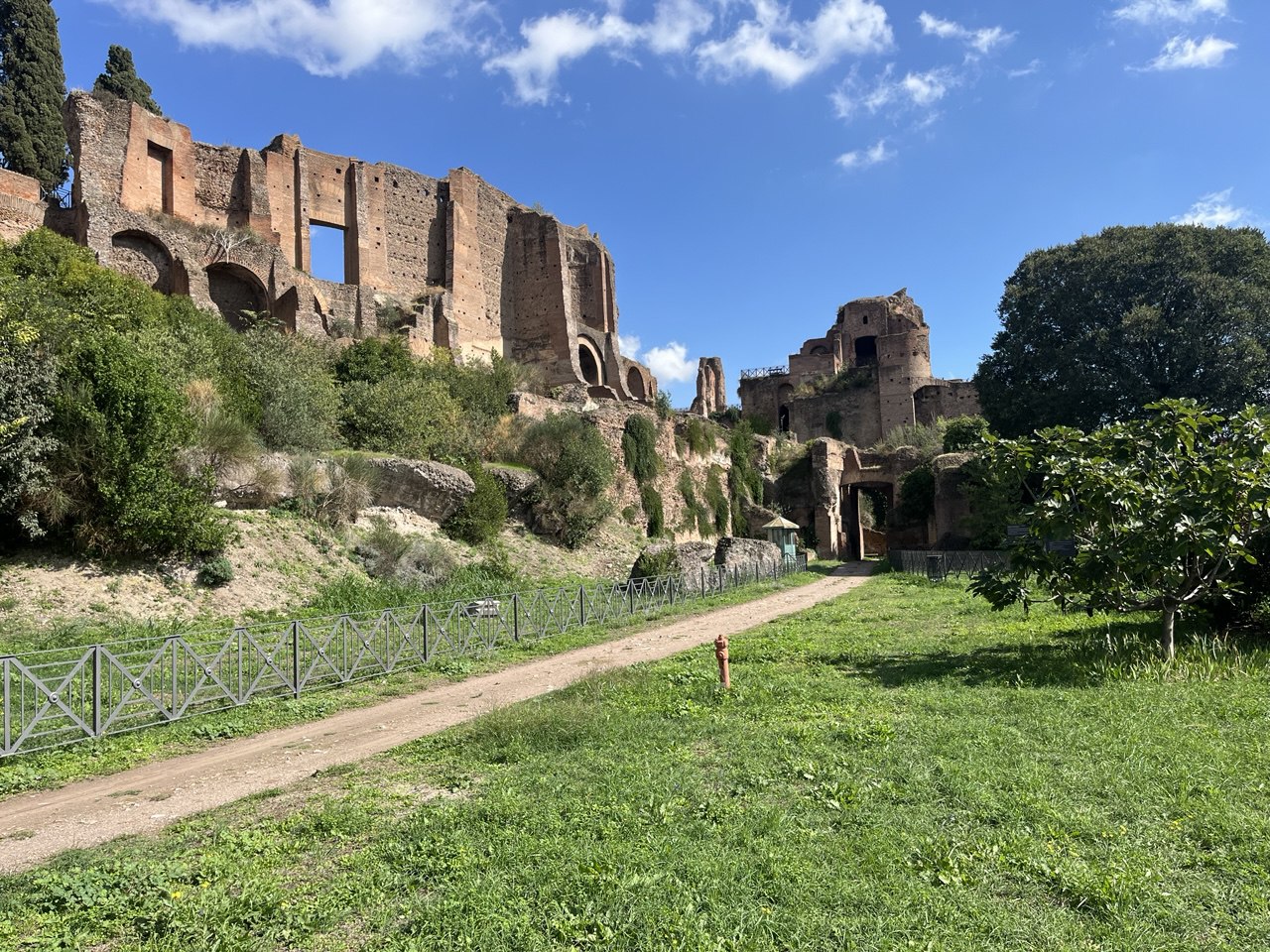
Director: Paolo Carafa
External links:
According to the Ancients on the Palatine Hill the rite of foundation of Rome would have been celebrated. In 2018, the research team of the Department of Classics concluded a long season of stratigraphic excavations on the northern slope of the hill, in the wide area between the so-called Clivo Palatino, the so-called Via Nova of the imperial age, the sanctuary of Giuturna and the Via Sacra. Investigations revealed a complex stratification extending between the 10th century BCE and the 16th century CE.
From the end of the 10th century BCE, hut cores arose on the slope, part of the large proto-urban settlement that developed on the site of Rome.
Between 775 and 750 BCE, this sector of the settlement was destroyed, and a new landscape was born. The Palatine is surrounded by a fortification with a gate surrounded by ramparts. The wall exploits the valley between Palatine and Velia as a defensive moat. Immediately outside the fortification are drawn new lots occupied by shrines, including that of Vesta, and a royal residence. In the second half of the 6th century BCE the walls are destroyed, the valley/moat is filled in, and on this fill the first Via Sacra paved with slabs is laid out. New luxurious dwellings are built, but the gateway to the walls is repurposed and all the older lots are preserved. The buildings within them are restored and if necessary rebuilt.
Only the Neronian fire of 64 CE destroys this topographic system. For the second time in the history of the slope a new landscape is born, different from the past. A new Sacra via lined with porticoes is built, and a horreum (warehouse) rises in place of the destroyed residential quarters. Of the older system only the temple of Vesta and the house of the Vestals are reconstructed in new forms while some of the oldest memories, such as the gateway to the Palatine and one of the cults dating back to the 8th century BCE (dedicated to Jupiter Stator?) are repurposed by relocating them to nearby, but different places from the original ones.
Also in 2018, thanks to the collaboration and support of the Colosseum Archaeological Park, a second phase of research was launched on the opposite side of the Palatine. This new project stems from the need to carry out a systematic analysis of the sector between the road that separated the complex of ancient buildings below the Church of St. Anastasia from the Circus Maximus, the domus Augustiana, the domus with two peristyles from the Augustan age that occupies the mid-slope of the hill and the scalae Caci.
In this area, which has never been investigated until now, structures are preserved that are partially known thanks to representations from the Renaissance period and, according to some of the most recent interpretations, pertaining to the complex of Augustus' sanctuary house (domus Palatina). This section of the slope represents a key sector not only for understanding the shape and configuration of the monumental residence desired by the first emperor, but also for reconstructing the topographical arrangements that connected in ancient times the House of Augustus with the surrounding architectural complexes: the new imperial palace extended from the Flavian age and the Circus Maximus.
In the first research campaigns, cleaning and surveying of the emergent structures, an electrical tomography, and mechanical coring were carried out to verify the consistency of the buried structures and the preserved stratification. This led to the creation of a new reconstructive proposal of the slope from the Augustan age to the Late Antique phase.
On the other hand, the investigations of 2021-2023 have focused on the remains of structures referable to the republican phases, the analysis of these fragments and the continuation of the investigations contributes to bring new light on the landscape of this portion of the urban center in the earliest phases.
Collaborators:
Mattia Ippoliti, Sara Bossi, Claudia Livrini, Paolo De Paolis, Alessandro Romei, Matteo Cattaneo, Elisa Peloso, Francesca Summa.
- Bibliography
Bibliografia 2015-2025
M. Ippoliti, La casa di Augusto sul Palatino, in Tetti degni di un dio. Fantasie e delizie dell'architettura abitativa dei Romani, Rizzoli, 2023, pp. 204-214.
M. Ippoliti, La casa di Ottaviano sul Palatino, in A. Carandini, P. Carafa, Tetti degni di un dio. Fantasie e delizie dell'architettura abitativa dei Romani, Rizzoli 2023, pp. 181-184.
M. Ippoliti, L'accesso al Palatino dal Velabro, in ArchCl LXXIV, 2023, pp. 789-807.
M. Ippoliti, La pendice meridionale del Palatino tra la Casa di Augusto e la chiesa di S. Anastasia, ArchCl LXXII, 2021, pp. 653-678.
A. Carandini, P. Carafa, M. Ippoliti, Dal mostro al principe. Alle origini di Roma, 2020.
P. Carafa, M. Ippoliti, Domus Palatina. Le nuove ricerche del Dipartimento di Scienze dell’Antichità sulla pendice meridionale del Palatino, SCIENZE DELL'ANTICHITÀ. - ISSN 1123-5713. - 25:1(2019), pp. 73-88.
M. Ippoliti, La pendice settentrionale del Palatino tra l'età augustea e l'età vespasianea attraverso il nuovo piano urbanistico neroniano, (2019), pp. 109-122. - MÉMOIRES - AUSONIUS.
P. Carafa, S. Bossi, C. Fanelli, M. Ippoliti, Il primo santuario di Vesta, ScAnt 24.1 2018, pp. 47-100.
P. Carafa, M. Ippoliti, S. Bossi, Dall’atrium Vestae all’Arco di Tito. Monumenti e storia della città. Lo scavo del Dipartimento di Scienze dell’Antichità sulle pendici settentrionali del Palatino, in ScAnt 23.1, 2017, pp. 89-133.
A. Carandini, P. Carafa, M.T. D'Alessio, D. FIlippi, Santuario di Vesta, pendice del Palatino e via Sacra, Roma 2017.
A. Carandini, M. Ippoliti, Giove Custode di Roma. Il dio che difende la città, 2016.
Further details about this research:
- Research type: Sapienza "Grandi Scavi"
- Location of the excavation: Rome, Palatine Hill
- Research topic: Roman Archaeology
- Fundings: Grandi Scavi di Ateneo