

Research > Sapienza Research Projects > Stages of the Emperor: Organization, Communication and Perception of Power
Principal Investigator: Mattia Ippoliti
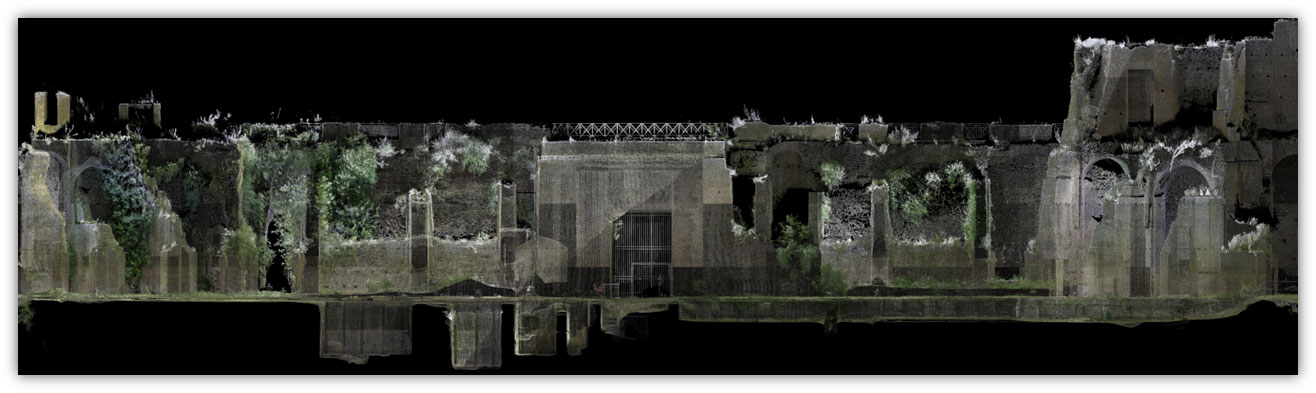
The aim of this project is to create an integrated system of knowledge, management and analysis of the context to be used for scientific research, conservation, management, enhancement and communication. The new survey will make it possible to create phase plans and reconstructions of different eras in order to analyse the buildings in relation to space management and the forms of organisation of the imperial court and power. This will make it possible to understand whether the traces of political and administrative reforms are legible in the design of the palaces, to analyse the communicative choices evidenced by the architecture and furnishings, and finally to investigate the perception that the ancients had of them.
Underlying this research project is the need to develop cultural heritage management systems that are effective in terms of conservation and enhancement and, at the same time, form the basis for producing up-to-date and updatable scientific content. One of the main objectives of the project is therefore to create and test a system that allows the management of data and archaeological sites and produces scientific and cultural communication content. The application of this system in a multi-layered complex such as the imperial palaces of the Palatine Hill will enable important scientific results to be obtained and a tool to be corrected and implemented that can be used in other contexts in Europe and around the world.
Once the system has been built, it will be possible to analyse the different phases of the imperial palaces' life and reconstruct their architecture, relating it to the evolution of imperial power.
The creation of phase plans and architectural reconstructions of the buildings will make it possible to reconstruct ancient contexts by repositioning objects that have been removed. Objects and architecture will be entered into a system to produce an integrated analysis of different sources of information: ancient and modern iconography, literary and epigraphic sources. A data management and analysis tool will be created to make all the available information accessible in order to understand the characteristics of each phase and connect the material remains of the imperial seat with the different phases of administration and management of the court.
For the first time, it will be possible to analyse the imperial palace as a single coherent context that has been modified over time to meet the new needs of the emperors. It will also be possible to try to understand the relationships between architectural choices and the organisation of the spaces and functions they were intended to accommodate. The relationships between ideology, the organisation of power and communication will also be examined, considering the imperial palaces as an integral part of the history of the Roman Empire and its political and social organisation. Finally, it will be possible to compare the different phases of the contexts with the accounts of ancient authors to illustrate society's perception of the message of power conveyed by the palace.
Collaborators:
Francesco De Stefano, Sara Bossi, Claudia Livrini, Nicolò Squartini, Alessandro Romei, Paolo De Paolis, Matteo Cattaneo, Francesca Summa, Luciana Amoruso, Lily Reinolds
- Bibliography
M. Ippoliti, P. Quaranta (a cura di), Atti della giornata di studi del 29 novembre 2024, cs.
Further details about this research:
- Research type: Progetto di ricerca piccolo
- Research topic: Roman Archaeology
- Fundings: SEED PNR 2022, Progetti di ricerca piccoli
| Image gallery | ||
|---|---|---|
 |  | |