

Research > Archaeological Fieldwork > Excavations in Italy > Excavations and Research in the South-Eastern Necropoleis of Vulci
Directors:
- Laura Maria Michetti;
- Alessandro Conti;
- Christian Mazet
External links:
Facebook - Ritorno a Vulci Project
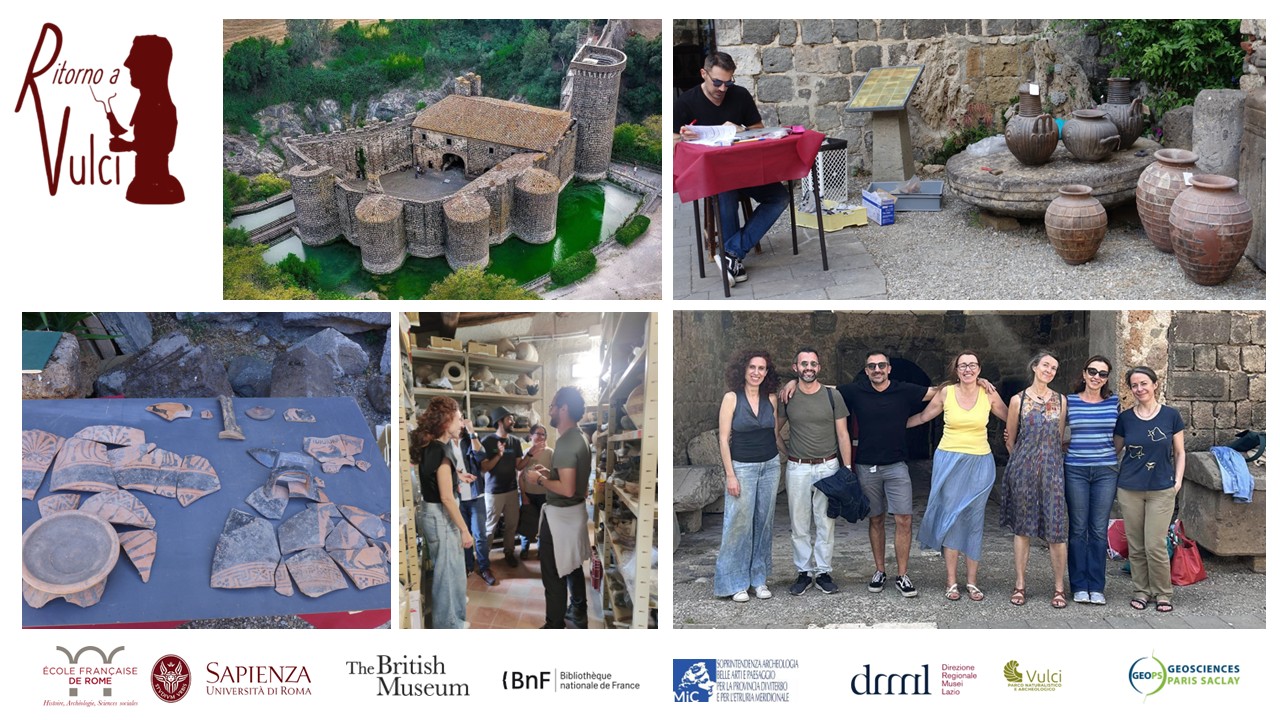
The “Return to Vulci” project inaugurates a new phase of research in the south-eastern necropoleis of Vulci, in the Polledrara/Legnisina or Agnesina sectors, continuing the nineteenth-century investigations conducted by Italian and French archaeologists and the subsequent conservation interventions carried out in the 1990s. The initiative has developed through an international scientific collaboration between the École française de Rome, the Department of Classics Sapienza University of Rome, the Greece and Rome Department of the British Museum, the Département des monnaies, médailles et antiques of the Bibliothèque Nationale de France, the Soprintendenza Archeologia, Belle Arti e Paesaggio for the province of Viterbo and southern Etruria, the Direzione Regionale Musei Lazio, and the Fondazione Vulci.
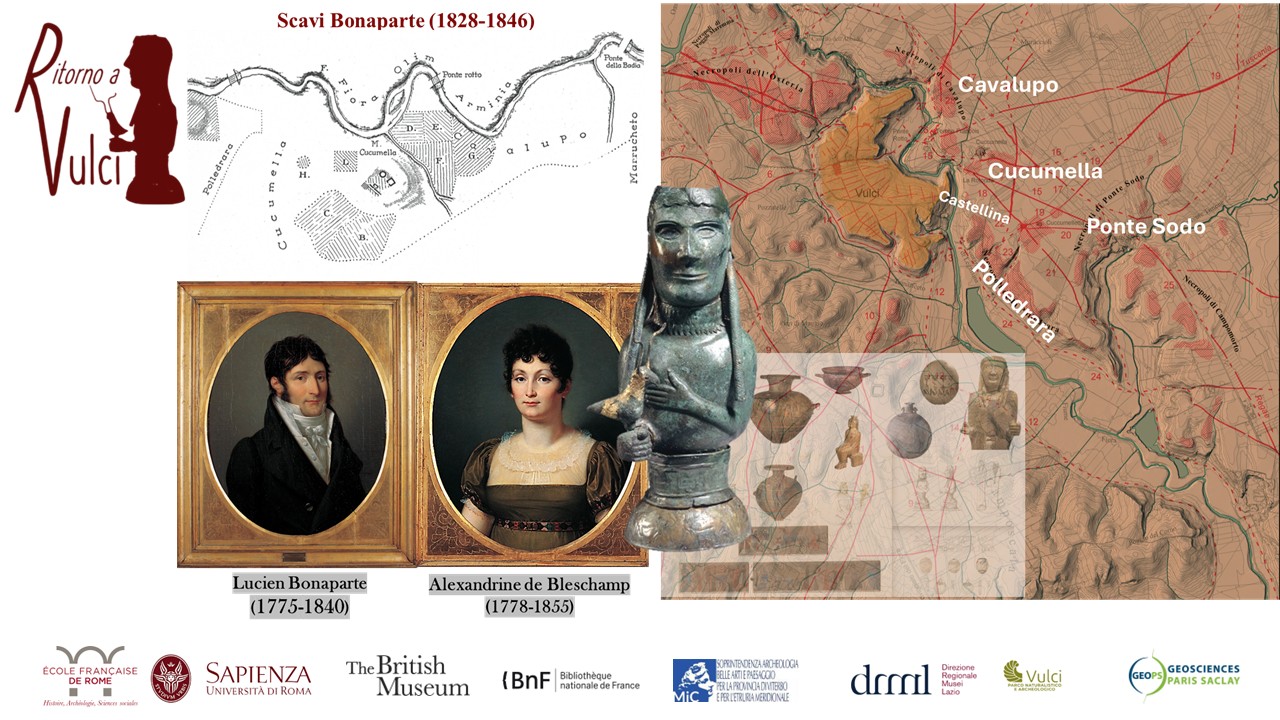
The Polledrara sector is known for the renowned Tomb of Isis, discovered by the Bonaparte couple in 1839, although nineteenth-century excavations had already begun in 1829 and included, among numerous tombs, the Cuccumelletta tumulus. Later, the excavations carried out by Francesco Mancinelli Scotti and Stéphane Gsell at the end of the nineteenth century brought to light funerary complexes dating from the Iron Age to the Hellenistic period, though their grave goods were unfortunately dispersed. Gsell also identified—but did not explore—a monumental tumulus located on the south-western edge of the necropolis.
In the twentieth century, the area suffered extensive looting, especially after the Land Reform of the Ente Maremma, with sporadic recoveries by the Soprintendenza. Among these are the “ Tomba del trono” of the Polledrara, from which the well-known gold-plated wooden head now in Milan, and the earlier “Tomba degli Ori”.
The project includes the reassessment of materials preserved in the storerooms of the Museums of Vulci and Villa Giulia, georeferencing the grave goods through cadastral research in an attempt to reconstruct the chronological development of the eastern necropoleis.
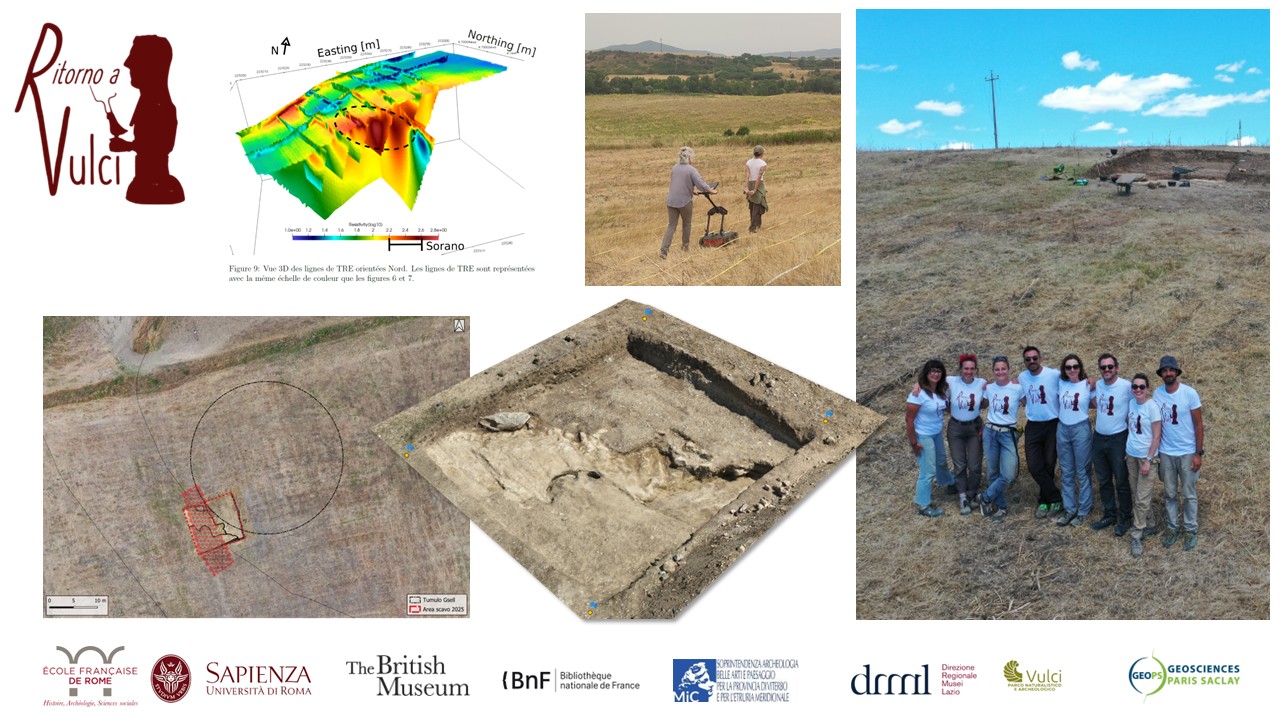
Fieldwork began in October 2023 with drone-based aerial photogrammetry and the creation of an integrated GIS incorporating LIDAR data, topographic maps, and geological surveys. Particular attention has been devoted to the Gsell Tumulus, one of the few known tumuli at Vulci, approximately 30 metres in diameter, never fully excavated and possibly preserving an intact main chamber. The 2024 geophysical investigations conducted by the GEOPS team of the Université Paris-Saclay employed ERT, ground-penetrating radar, and electromagnetic induction, identifying anomalies consistent with tombs and tumulus structures, already suggested by RAF and SIAT aerial photography.
During the summer of 2025, an initial test trench was opened in the south-western quadrant of the tumulus to verify conductive anomalies and traces of the nenfro crepis, revealing fluvial deposits and geological strata reused for earlier tombs. Several tombs show clear evidence of looting and agricultural disturbance, highlighting the complex transformation of the site.
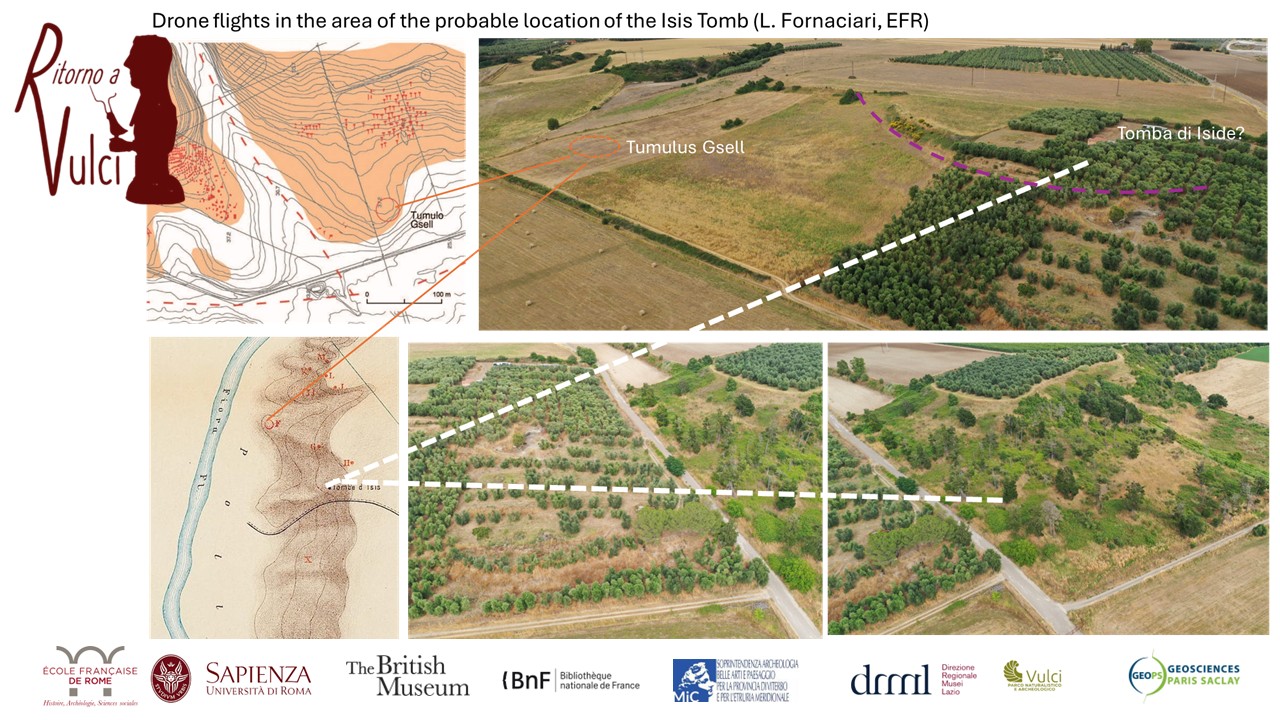
Further interest concerns the possible location of the Tomb of Isis, situated along a line of other chambers overlooking the area to the south of the Gsell Tumulus, likely an important landmark within the funerary landscape.
The project represents an example of integrated archaeology, combining fieldwork, archival research, and the study of museum collections, all systematized within a GIS platform, in order to enhance and recontextualize the dispersed heritage of Vulci.
Collaborators:
- Alexandra Villing
- Cécile Colonna
- Lorenzo Fornaciari
- Emmanuel Léger
- Alison Pereira
- Albane Saintenoy
- Bibliography
A. Conti, L. Fornaciari, C. Mazet, L. M. Michetti, Retour(s) à Vulci : archéologies d’archives, de musées et de terrain , in Revue archéologique, 79(1), 204-215.
A. Conti, C. Mazet, L. M. Michetti, ‘Ritorno a Vulci’. New tools for the study of the south-eastern necropolises , in F. Bortolami, G. Gambacurta (ed.), Necropoli etrusco-italiche: archeologia digitale e paesaggio funerario. Atti del workshop (Venezia 2023), Archeologia e Calcolatori, 35.1, 2024, p. 67-80.
Further details about this research:
- Research type: Excavation in Italy
- Location of the excavation: Canino (VT)
- Research topic: Etruscology
- Fundings: École française de Rome
| Image gallery | ||
|---|---|---|
 |  |  |
 | ||